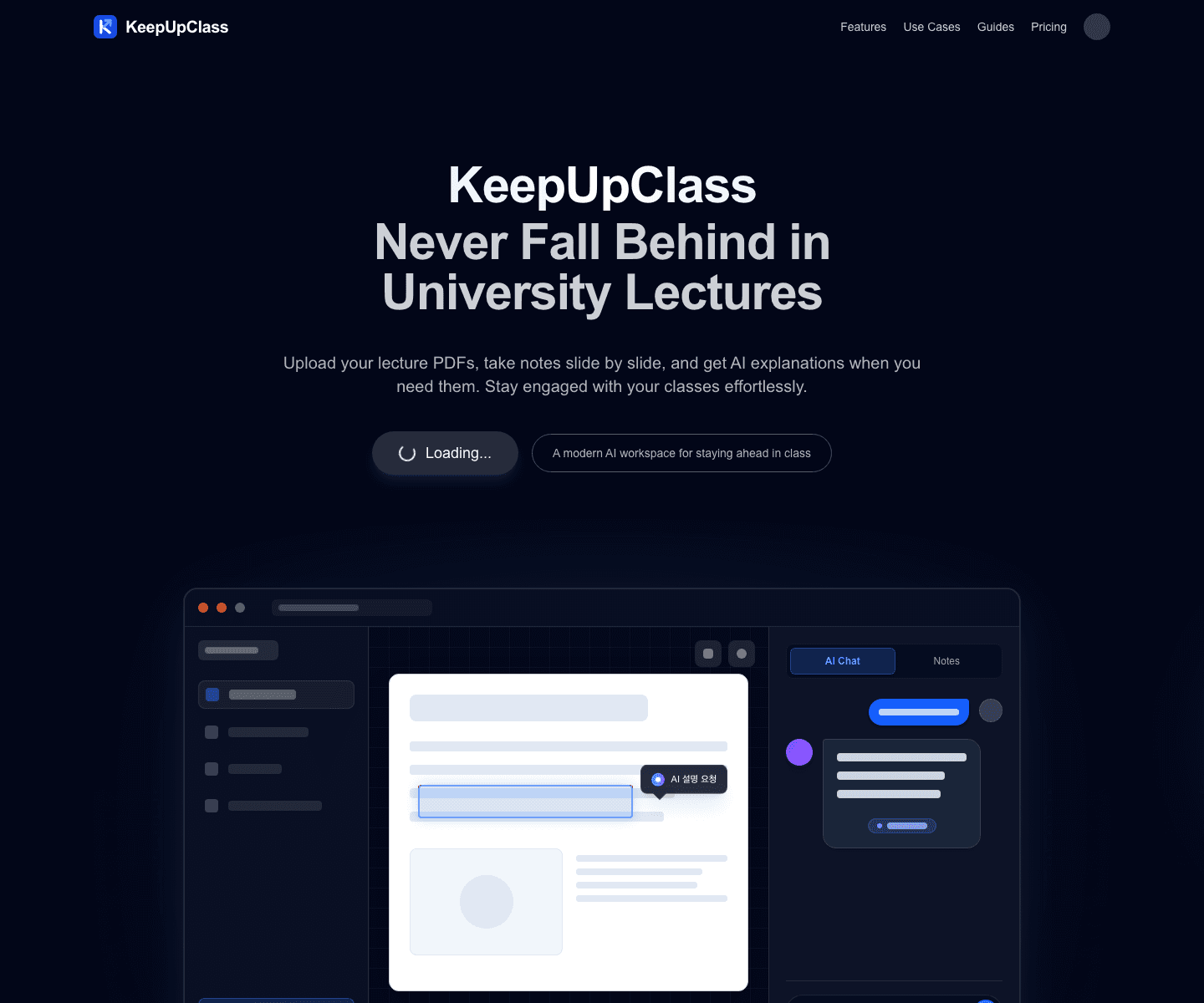
The hero is useful evidence because it makes the academic promise legible before the visitor has to inspect any deeper part of the product.
Journal
KeepUpClass is not interesting because it contains note-taking or AI features. Many education products can claim those. What makes it worth explaining is the way those features are organized around lecture structure instead of being treated as detached tools.
Editorial note
Prepared by LaunchForge from direct review of the KeepUpClass landing page, feature cards, and visible study-flow sections on the public site.
Reviewed on 2026-03-10
The hero is useful evidence because it makes the academic promise legible before the visitor has to inspect any deeper part of the product.
Students do not experience a lecture as free-floating text. They experience it through sequence, context, and reference points tied to lecture material. A generic notes surface can capture information, but it can still weaken the student’s relationship to the actual structure of the class.
That is why KeepUpClass uses lecture slides as the center of gravity. It keeps note-taking anchored to the same structure students already encounter during class instead of asking them to reconstruct that context later.
AI support becomes much less helpful when it is bolted onto a product as a detached chat surface. Students usually need explanation in the middle of a workflow, while reading a lecture artifact or trying to understand one step in a sequence.
KeepUpClass treats AI explanation as one part of a broader academic flow that includes upload, slide-based context, note capture, and later review. That makes the product more coherent and more defensible.
The public landing page does important work here. It already makes the product promise explicit with sections such as slide-by-slide note taking, AI-powered explanations, and export-oriented study support.
Just as important, the site turns that promise into a concrete sequence: upload, take slide-by-slide notes, ask for AI help, and export for review. That is stronger evidence than a generic AI-study pitch because the workflow is visible before a user ever logs in.
KeepUpClass reinforced that a good educational product should respect the learner’s actual sequence of work. Product clarity improves when the software mirrors the user’s real context instead of forcing them into a generic tool model.
For LaunchForge, that is a durable principle. Good workflow software is usually built around the sequence the user is already living through, not around a detached feature list.