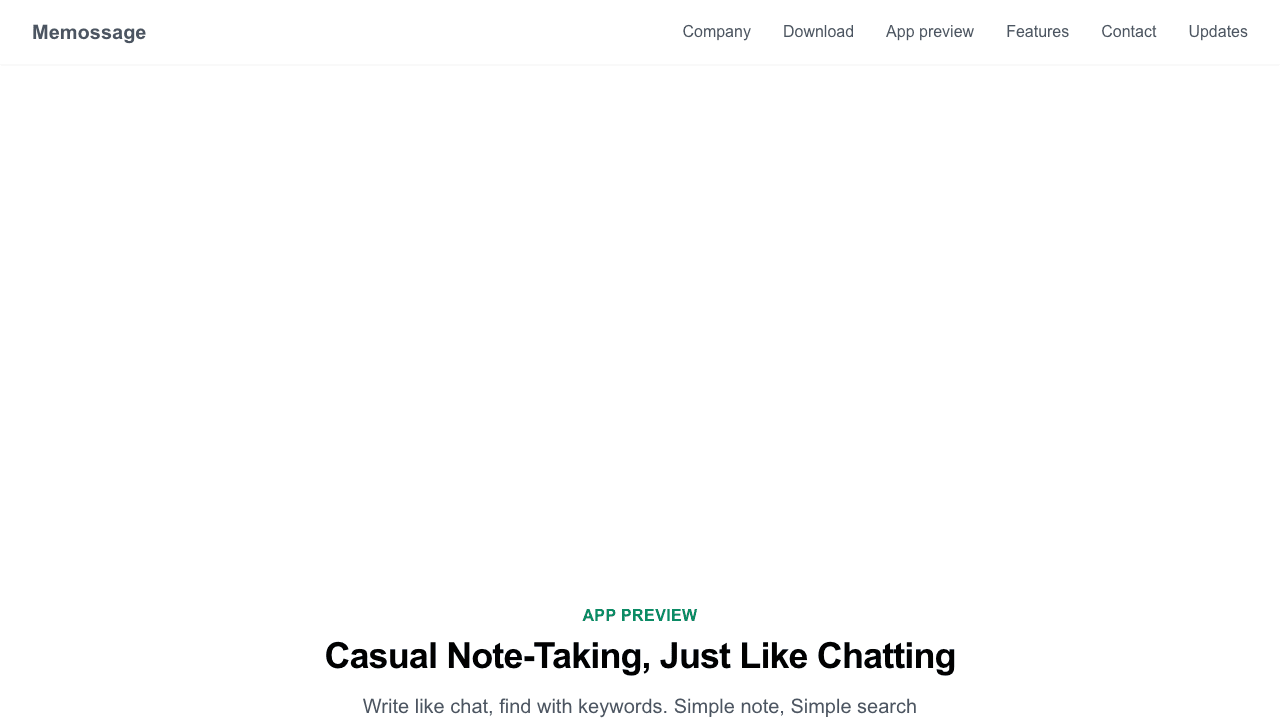
The public Memossage homepage makes the product thesis legible before a visitor ever reads a detailed explanation.
Journal
Memossage began with a simple product question: if capturing a note felt as easy as sending yourself a message, would people save more ideas before losing them? That question stayed useful because it forced LaunchForge to choose one behavior to optimize instead of launching another broad notes surface with generic promises.
Editorial note
Prepared by LaunchForge from direct review of the public Memossage homepage and release notes, with screenshots captured from the live site.
Reviewed on 2026-03-10
The public Memossage homepage makes the product thesis legible before a visitor ever reads a detailed explanation.
Many note products begin by asking users to define structure first. That can make sense later, but it often gets in the way during the moment a thought needs to be captured quickly. The first version of Memossage was built around the opposite assumption: the user should be able to start writing immediately.
That made the chat-like interaction valuable. It reduced startup friction and gave the product a behavior that was easy to understand in public. The interaction was not chosen for novelty. It was chosen because a familiar message-like flow lowers the cost of action.
A lightweight capture model only stays useful if retrieval scales with it. As Memossage grew, the product expanded into search, folders, media support, checklists, and export. Those were not random feature additions. They were the structural support needed to keep the original capture promise viable once note volume increased.
That sequence matters. LaunchForge did not begin by building a heavier product and then trying to make it feel simple. It started from a narrow interaction thesis and added depth only where the public product needed it.
The public release notes are useful not only for users, but also for LaunchForge itself. They make iteration visible. That visibility changes how a product is judged because it shifts the public story from “we launched an app” to “we are maintaining and improving a product in the open.”
For a product studio, that is important. A static launch page can say almost anything. A maintained release history is harder to fake and more useful as proof of work quality.
Memossage reinforced an idea LaunchForge keeps returning to: a product becomes easier to improve when the first version is built around one legible behavior. That gives the team a clear center of gravity when deciding what should expand and what should stay minimal.
In Memossage, that center remained fast capture. Everything else had to justify itself in relation to that behavior. That discipline is part of what makes the product valuable as a public case study.